Lilla Jewel Awards
Seeding Justice is pleased to recognize the most recent winners of the Lilla Jewel Award, Erica Alexia Ledesma and Dharma Mirza. The awards support Oregon-based artists of marginalized genders advancing social change.
In recognizing the power of art and the work of awardees, Executive Director Se-ah-dom Edmo says, “Art has always been central to social change. Think of the songs that carried the Civil Rights Movement. The murals that reclaim public space. The poetry that refuses to forget. Art doesn’t just reflect the world—it shapes it. Erica and Dharma shape it.”
The Lilla Jewel Award—named in honor of artist, radical feminist, and suffragist Lilla Jewel—was created to address these inequities by resourcing and amplifying Oregon-based artists of marginalized genders who advance a social change message through their work. Created in 1997, the awards have funded dozens of poets, choreographers, singers, painters, photographers, filmmakers, writers, and other artists embedded in our social justice movements.
The awards were announced on October 2 at the Portland Art Museum during Seeding Justice’s Within Reach gala, which marked the organization’s 50th anniversary.
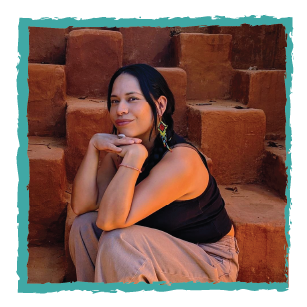
Erica Alexia Ledesma (she/they) is a first-generation Xicana visual artist, cultural worker, and organizer born and raised in Southern Oregon, with deep roots in Nayarit and Zacatecas, México. Her multidisciplinary practice brings together screen printing, mixed media, digital illustration, and oral storytelling to explore identity, culture, and the political.
Through projects like Noche de Cuentos and De La Raíz, Erica creates spaces that uplift Latine stories, honor lived experiences, and carry knowledge and culture through oral tradition. Her art is deeply rooted in community organizing and activism, with artwork and public art installations supporting movements and community efforts locally and nationally.
At the heart of Erica’s practice is a commitment to reclaiming narratives, making culture visible, and creating space for communities to see themselves reflected in the stories being told. She hopes to continue growing a creative practice that weaves together visual art, storytelling, and community; expands opportunities for Latine artists and storytellers; and helps cultivate a future where our stories and cultural ways are celebrated.
What gives her strength are her grandparents, who spent the final 15 years of their lives in the Rogue Valley. They brought with them stories, and sacred maíz seeds that her family continues to grow each year, reminding Erica that culture is something we inherit, nurture, and carry forward.
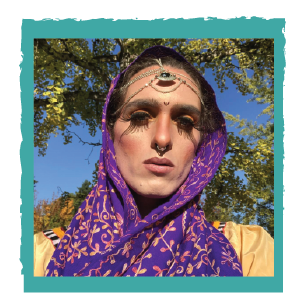
Dharmakrishna Mirza (she/they) is an artist, scholar, researcher, and cultural health community educator based in Corvallis, Oregon, where she currently attends Oregon State University. Dharma is pursuing a PhD in Women, Gender, and Sexuality Studies and Public Health.
Dharma is part of the Khwaja Sira/Hijra community, an Indigenous gender and ethnic community in South Asia. As a mixed-race trans femme of color and a queer, intersex, first generation Pakistani Muslim immigrant, Dharma finds solace in art as a means of making sense of a world that often assumes women like her simply could not exist. As a public official, Dharma serves on numerous boards and commissions and in appointed council positions.
In the community, Dharma uses performance art, spectacle, and resistance punk drag to embody the theory and resistance she teaches about in her classrooms. Dharma is the mother of a local drag family, the Haus of Dharma, where she blends American ballroom culture with the surviving Hijra gender performance traditions of her Pakistani heritage. Through a variety of subversive characters, Dharma challenges gender normativity, critiques white supremacist cultural expectations of purity and professionalism, and carves a gender fucked pathway of liberation for the next generation of trans femme leaders and visionaries.
Dharma hosts a variety of drag performances, gallery installations, and talks across the Willamette Valley. When she is not performing, Dharma serves as the Director of Development and Research for the Rural Rainbow Coalition, where she works to establish Corvallis’ first permanent, community based LGBTQI+ community center and cultural kitchen while revitalizing the Corvallis Pride Festival.
Eligibility
To be eligible for an award, applicants must:
- Be Oregon residents;
- Be at least 18 years of age; and
- Be of a marginalized gender, including trans and cis women, trans men, nonbinary people, gender non-conforming people, intersex people, and people of all genders that have been historically underrepresented and/or oppressed by structures of power.
Priorities
We are looking for artists whose work is:
- Steeped in social justice, touching on and calling the public to confront and address racial, economic, disability, gender and/or environmental injustice;
- Has strong social engagement and collaboration within their communities;
- Relevant to the struggles of social justice movements and communities most impacted by injustice.
Process
This award specifically seeks to support and recognize artists through an unrestricted and open award, not necessarily a particular art piece or project. We want to reward and invest in artists as activists who contribute to, elevate, educate within, and lend support to Oregon’s social, racial, environmental, economic, disability, and gender justice movements in Oregon.
Each year, the Lilla Jewel Award Committee—composed of former Lilla Jewel Award winners—selects one or more artists to receive an award.
Awards are $10,000 per artist and if selected, artists may serve in the Lilla Jewel Award Committee.
Applications are currently closed. They will open again in the first half of 2026.
Because this is an award made to an individual, it’s considered taxable income, and will be reported on Form 1099-MISC. If this presents a problem for you, please let us know and we will work with you to find a solution.
Open Opportunities
If there are open opportunities, they will be listed through our Submittable page, below. Make sure to sign up for our newsletter to be notified when they open.
Lilla Jewel Award Application and scoring guide
Frequently Asked Questions
The Lilla Jewel Award typically opens the application cycle each Spring. You can apply for the award via our online platform, Submittable. The first time you apply, you will need to create an account with your email address and a password. If you don’t see the application in Submittable, that means that the application is not open at this time.
Yes. If you’d like to look at the most current application questions, you may download them here.
Please note that we may make changes to the application from one cycle to the next, so make sure you check out the most recent version in Submittable once the application opens.
This opportunity is open to artists of marginalized genders: trans and cis women, trans men, nonbinary people, gender non-conforming people, intersex people, and people of any gender that have been historically underrepresented and/or oppressed by structures of power.
Applicants can can be musicians, performers, filmmakers, dancers, writers, poets, photographers, printmakers, sculptors, and multi-disciplinary and spoken-word artists, among many others.
Applicants do not need to be considered “professionals” or work full time in the arts in order to qualify, but their work must reach an audience in order to have an impact.
Artists must live and work in Oregon and must be at least 18 years old.
The Lilla Jewel Award Committee—composed of former Lilla Jewel Awardees—reads and scores applications after the award cycle is closed and meet to deliberate around June and make decisions.
At this point, only individual artists are allowed to apply.
If you can’t find an answer to your questions in the FAQ, please contact us.